

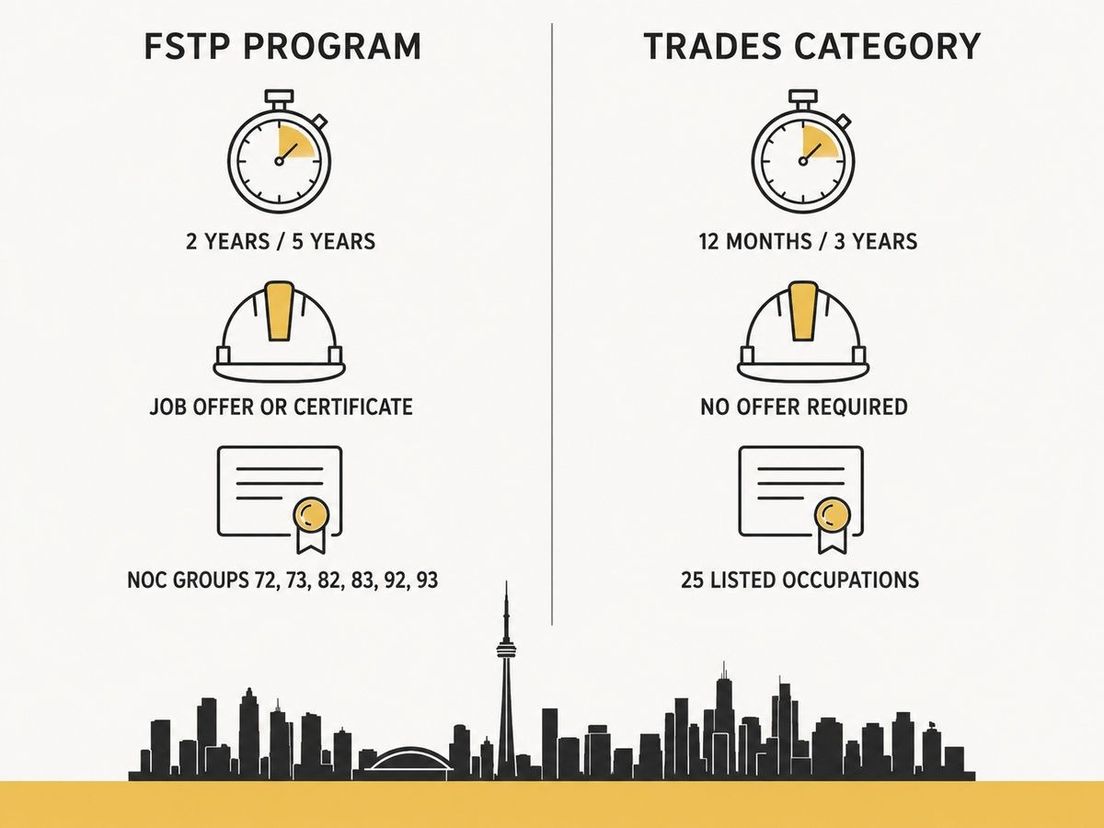
The Federal Skilled Trades Program (FSTP) is one of three federal pathways managed through Express Entry, and it is the only one built specifically for people who work with their hands. It requires no degree, no diploma, and no Canadian work experience. What it does require is two years of experience in an eligible trade, a job offer or a provincial certificate of qualification, and language ability at a threshold well below what the other federal programs demand.
The program matters more in 2026 than it has in years. Skilled trades remain one of Immigration, Refugees and Citizenship Canada's priority categories, and targeted trades draws have invited candidates at scores far below general cut-offs. But there is a distinction that trips up most applicants: qualifying for the FSTP and qualifying for a trades category draw are two separate tests, and the occupation lists do not match. This page covers both, along with the fees, documents, and refusal risks that follow.
Federal Skilled Trades Program Eligibility Requirements
FSTP eligibility is a pass or fail assessment. There is no points grid to clear the way there is under the Federal Skilled Worker Program, but every requirement below must be met independently.
Eligible NOC Groups for FSTP Work Experience
All of your qualifying experience must sit in a single National Occupational Classification code, and that code must fall within one of these groups:
- Major Group 72 excluding Sub-Major Group 726: technical trades and transportation officers, covering machinists, welders, electricians, plumbers, carpenters, and industrial mechanics.
- Major Group 73: general trades, including concrete finishers, roofers, painters, and floor covering installers.
- Major Group 82: supervisors in natural resources, agriculture, and related production.
- Major Group 83: occupations in natural resources and related production.
- Major Group 92: processing, manufacturing, and utilities supervisors and central control operators.
- Major Group 93 excluding Sub-Major Group 932: central control and process operators and aircraft assemblers.
- Minor Group 6320: cooks, butchers, and bakers.
- Unit Group 62200: chefs.
Note the two exclusions carefully, because they are frequently misreported. Sub-Major Group 726 is excluded from Major Group 72, and Sub-Major Group 932 is excluded from Major Group 93. Beyond sitting in the right group, you must have performed the actions described in the lead statement of your NOC and most of the main duties listed under it, and you must meet the employment requirements set out for that trade, apart from the certificate requirement itself.
Two Years of Skilled Trades Work Experience Within Five Years
You need at least two years of full-time paid work experience, or 3,120 hours in total, gained in the five years before you apply. IRCC counts those hours in several ways:
- Full time at one job: up to 30 hours per week for 24 months.
- Part time: any combination adding up to 3,120 hours, across as many part-time jobs as needed.
- Full time across multiple jobs: 30 hours per week for 24 months spread over more than one employer.
Hours worked beyond 30 per week are not counted, so a 60-hour week does not compress your timeline. The experience must have been paid in wages or commission, which rules out volunteer work and unpaid internships, and it must have been gained in a country where you were legally qualified to practise that trade independently. If you qualified in one country but worked in another with different rules, you needed to satisfy the second country's requirements as well. Work performed while you were a student does not count toward the minimum.
Job Offer or Certificate of Qualification Requirement
You must hold one of two things, not both. Either a valid job offer for continuous full-time employment lasting at least one year, from up to two Canadian employers in your trade, or a certificate of qualification in that trade issued by a Canadian provincial, territorial, or federal authority. This requirement is what most distinguishes the FSTP from the other Express Entry programs, and it is the requirement that stops most otherwise-qualified tradespeople. A qualifying job offer may also require a Labour Market Impact Assessment depending on the employer and the exemption category involved.
FSTP Language Requirements at CLB 5 and CLB 4
You must take an approved test and meet Canadian Language Benchmark 5 in speaking and listening, and CLB 4 in reading and writing. Each ability is assessed on its own, so a strong reading score cannot offset a weak speaking score. Accepted English tests are CELPIP-General, IELTS General Training, and PTE Core. For French, TEF Canada and TCF Canada are accepted, and NCLC levels map directly onto the CLB scale. Results are generally valid for two years and must be valid both when you create your profile and when you submit your permanent residence application.
Proof of Funds Requirements for FSTP Applicants
You must show settlement funds unless you are both authorized to work in Canada and hold a valid job offer. Family size includes you, your spouse or common-law partner, your dependent children, and your partner's dependent children, counted even if they are Canadian citizens or permanent residents and even if they are not coming with you.
| Number of family members | Funds required (CAD) |
|---|---|
| 1 | $15,263 |
| 2 | $19,001 |
| 3 | $23,360 |
| 4 | $28,362 |
| 5 | $32,168 |
| 6 | $36,280 |
| 7 | $40,392 |
| Each additional family member | Add $4,112 |
These figures reflect the table IRCC last updated on July 7, 2025. The amounts are recalculated annually at 50 percent of the low income cut-off totals, so confirm the current figures before relying on them. The funds must be liquid and legally accessible to you on arrival, which excludes real estate equity and borrowed money.
No Education Requirement Under the Federal Skilled Trades Program
There is no minimum education requirement for FSTP eligibility. Education still affects your ranking once you are in the pool: a Canadian high school or post-secondary credential earns points directly, and foreign education earns points if you obtain an educational credential assessment. For candidates whose scores sit close to a draw cut-off, an assessment is often the cheapest available improvement.
Certificate of Qualification for Skilled Trades in Canada
A certificate of qualification confirms that you passed a certification exam and meet the requirements to practise your trade in the province or territory that issued it. It is not the same as a job offer, and it is not the same as an apprenticeship record. It also carries CRS value beyond eligibility, since a certificate of qualification combined with adequate language ability adds points to your ranking.
Provincial and Territorial Trade Certification Bodies
Each province and territory runs its own certification process and maintains its own list of designated trades. The authority assesses your training, experience, and skills to decide whether you may sit the certification exam. In practice this can mean travelling to the province for assessment, or gaining Canadian experience under an employer before you are eligible to be tested. Timelines vary widely between jurisdictions, and this step is usually the longest part of an FSTP file.
The critical planning point: if the province or territory where you intend to settle does not issue certificates in your specific trade, that route is closed to you and you will need a valid job offer instead. Check the designated trades list for your target province before you build a strategy around certification. Provinces also nominate tradespeople directly through their own streams, so a trades-focused pathway under the Provincial Nominee Program may run in parallel with, or instead of, a federal FSTP application.
Federally Regulated Trades and Credential Assessment
Some trades are regulated federally rather than provincially. Aircraft mechanics are the standard example. If your trade is not on any provincial designated list, confirm whether a federal authority governs it before concluding that certification is unavailable to you.
FSTP Program Eligibility Compared With Express Entry Trades Category Eligibility
This is the distinction that costs candidates the most time. Being eligible for the Federal Skilled Trades Program puts you in the Express Entry pool. Being eligible for the trades category determines whether you can be invited in a targeted trades draw. They are different tests with different occupation lists, different experience requirements, and different reference periods.
Trades category eligibility requires 12 months of full-time experience, or the part-time equivalent, accumulated within the past three years in a single listed occupation. That experience does not need to be continuous and may have been gained in Canada or abroad. Compare that with FSTP program eligibility: two years within five years, with a mandatory job offer or certificate of qualification. A candidate can satisfy one and fail the other.
Eligible Occupations in the Express Entry Trades Category
The trades category currently covers 25 occupations:
| Occupation | NOC 2021 code | TEER |
|---|---|---|
| Construction estimators | 22303 | 2 |
| Construction managers | 70010 | 0 |
| Home building and renovation managers | 70011 | 0 |
| Machinists and machining and tooling inspectors | 72100 | 2 |
| Sheet metal workers | 72102 | 2 |
| Welders and related machine operators | 72106 | 2 |
| Electricians, except industrial and power system | 72200 | 2 |
| Industrial electricians | 72201 | 2 |
| Plumbers | 72300 | 2 |
| Gas fitters | 72302 | 2 |
| Carpenters | 72310 | 2 |
| Cabinetmakers | 72311 | 2 |
| Bricklayers | 72320 | 2 |
| Construction millwrights and industrial mechanics | 72400 | 2 |
| Heavy-duty equipment mechanics | 72401 | 2 |
| Heating, refrigeration and air conditioning mechanics | 72402 | 2 |
| Electrical mechanics | 72422 | 2 |
| Water well drillers | 72501 | 2 |
| Other technical trades and related occupations | 72999 | 2 |
| Concrete finishers | 73100 | 3 |
| Roofers and shinglers | 73110 | 3 |
| Painters and decorators, except interior decorators | 73112 | 3 |
| Floor covering installers | 73113 | 3 |
| Contractors and supervisors, oil and gas drilling and services | 82021 | 2 |
| Butchers, retail and wholesale | 63201 | 3 |
Chefs and Cooks Qualify for FSTP but Not for Trades Category Draws
Cooks and chefs sit inside the FSTP-eligible NOC groups, Minor Group 6320 and Unit Group 62200 respectively, which means a qualifying chef can enter the Express Entry pool under the FSTP. Neither occupation appears on the trades category list. The practical effect is that food trades candidates are eligible for the program but cannot be invited through a targeted trades round, and must instead compete in draws open to their profile. Anyone building a plan around a trades draw needs to confirm their occupation against the category list rather than assuming FSTP eligibility carries across.
Construction Managers and Estimators Qualify for Trades Draws but Not for FSTP
The mismatch runs the other way as well. Construction managers, home building and renovation managers, and construction estimators all appear on the trades category list, but none of their NOC codes fall within the FSTP-eligible groups. Candidates in these occupations must qualify for the pool through the Federal Skilled Worker Program or the Canadian Experience Class instead, and can then be invited in a trades round once they are in the pool. Butchers are the useful exception: NOC 63201 sits inside Minor Group 6320, so butchers qualify on both tests.
Federal Skilled Trades Program Compared With FSWP and CEC
| Requirement | FSTP | FSWP | CEC |
|---|---|---|---|
| Minimum work experience | 2 years in 5 years | 1 year in 10 years | 1 year in Canada in 3 years |
| Language minimum | CLB 5 speaking and listening, CLB 4 reading and writing | CLB 7 in all abilities | CLB 7 for TEER 0 or 1, CLB 5 for TEER 2 or 3 |
| Education requirement | None | Assessed on the 67-point grid | None |
| Job offer or certificate | Required | Not required | Not required |
| Proof of funds | Required unless exempt | Required unless exempt | Not required |
| Separate points threshold | None | 67 of 100 points | None |
All three programs feed the same pool and are ranked together on the Comprehensive Ranking System, so the choice is rarely about preference. Most candidates qualify for one, occasionally two, and the system will consider you under any program you are eligible for. Successful applicants under any of these routes arrive as permanent residents with the same status and the same eventual permanent residence obligations.
Federal Skilled Trades Program Application Process
Step 1: Confirm Your NOC Code and Program Eligibility
Identify the single NOC code that matches your actual duties, not your job title, and confirm it falls within an eligible FSTP group. Compare your duties against the lead statement and main duties for that code. A mismatched NOC is grounds for refusal and, in serious cases, a misrepresentation finding.
Step 2: Obtain Your Certificate of Qualification or Secure a Job Offer
Start this early. Provincial assessment and examination can take many months, and in some trades requires you to be physically present or to have Canadian experience first. If certification is not available in your target province for your trade, pivot to securing a qualifying job offer instead.
Step 3: Complete Your Language Test
Book an approved English or French test and confirm you meet CLB 5 in speaking and listening and CLB 4 in reading and writing. If your score sits near a cut-off, a retest is usually the fastest and cheapest CRS improvement available.
Step 4: Create and Submit Your Express Entry Profile
Submit your profile online. Most information is self-declared at this stage and no documents are uploaded, but everything you declare must be supportable later. You will receive a CRS score and enter the pool, where you can also monitor Express Entry draws to see how your score compares against recent rounds.
Step 5: Receive an Invitation to Apply
Invitations are issued in general, program-specific, and category-based rounds. If you are invited, you have 60 days to submit a complete application for permanent residence.
Step 6: Submit Your Complete Application and Biometrics
File your electronic application with all supporting documents, pay the applicable fees, and attend your biometrics appointment once IRCC issues the instruction letter.
Step 7: Receive Confirmation of Permanent Residence and Land in Canada
On approval you receive a Confirmation of Permanent Residence and, where applicable, a permanent resident visa. You activate your status on arrival at a port of entry. Your PR card follows, and you will need to renew your PR card before it expires to keep travelling in and out of Canada by commercial carrier.
Documents Required for a Federal Skilled Trades Program Application
- Reference letters from every qualifying employer: on company letterhead, listing your position, dates of employment, hours per week, salary, and a duties description matching your declared NOC. Incomplete reference letters are the single most common cause of returned applications.
- Certificate of qualification or job offer documentation: the certificate issued by the provincial, territorial, or federal authority, or the written job offer and any supporting labour market documentation.
- Language test results: valid at both profile creation and application submission.
- Proof of funds: official letters on financial institution letterhead showing account numbers, opening dates, current balances, six-month average balances, and outstanding debts.
- Police certificates: from every country where you lived six months or more since turning 18.
- Immigration medical examination: completed with an IRCC panel physician.
- Identity and civil status documents: passports, birth certificates, marriage or divorce records, and certified translations where documents are not in English or French.
FSTP CRS Scores and Trades Category Draw Cut-Offs
There is no fixed CRS cut-off for the FSTP. Each round's cut-off is simply the score of the lowest-ranked candidate invited, which depends on how many invitations IRCC issues and who is sitting in the pool that day. Because FSTP candidates are not required to hold formal education, they often carry lower human capital points than degree-holding competitors, which makes targeted trades rounds the realistic route for most tradespeople.
Recent trades rounds illustrate the gap. The first trades category draw of 2026, held on April 2, issued 3,000 invitations at a cut-off of 477. The previous trades round, in September 2025, issued 1,250 invitations at 505. Both sat well below the Canadian Experience Class rounds running through the same period, which have generally cleared above 500. The 2026 figure also reflects the removal of cooks from the category, which changed the composition of the eligible sub-pool considerably.
Treat those numbers as a snapshot rather than a forecast. Cut-offs move with each round, and IRCC does not announce dates or targets in advance. The levers you can actually control are language scores, a certificate of qualification, a qualifying job offer, and a provincial nomination, which adds 600 points and effectively guarantees an invitation. You can estimate your standing with a CRS score calculator before committing to a strategy. Current categories and their occupation lists are published on the IRCC category-based selection page and are revised annually.
Federal Skilled Trades Program Fees and Costs
IRCC increased permanent residence fees on April 30, 2026. A single FSTP applicant now pays $990 in processing fees plus a $600 Right of Permanent Residence Fee, totalling $1,590, plus $85 for biometrics. An accompanying spouse or common-law partner pays the same $990 and $600. Each dependent child pays $270 in processing fees and no RPRF. Biometrics are capped at $170 for two or more family members applying together.
The RPRF may be paid upfront or deferred until IRCC requests it, and it is refundable if your application is refused or withdrawn. Note that the fee owed is the amount in effect on the date you pay, not the date you applied, which catches applicants who deferred the RPRF across a fee increase. Third-party costs sit outside these figures: language testing, educational credential assessment, medical examinations, police certificates, certified translations, and provincial certification fees all vary by country and trade.
Common Reasons Federal Skilled Trades Program Applications Are Refused
- Reference letters that omit required details: missing hours per week, salary, or a duties list that does not map to the declared NOC.
- Incorrect NOC selection: choosing a code by job title rather than by actual duties, or splitting experience across two codes so neither reaches the threshold.
- Experience gained without qualification to practise: hours worked in a country where you were not licensed to practise that trade independently do not count.
- Expired language results: tests valid at profile creation but expired by the time the application is submitted lead to rejection.
- Proof of funds shortfalls: balances that meet the threshold on paper but fail the six-month average test, or funds that are not liquid and accessible.
- Counting student work experience: hours worked while studying do not count toward the FSTP minimum.
Admissibility and Settlement Requirements Outside Quebec
You must be admissible to Canada. Security, criminal, and medical grounds can each result in inadmissibility, though outcomes turn on the specific facts. Depending on the nature of the offence and the time elapsed since a sentence was completed, criminal rehabilitation may be available, and medical inadmissibility depends on whether a condition would place excessive demand on health or social services.
FSTP candidates must also intend to settle outside Quebec, which selects its own economic immigrants through a separate system. Experience gained while living in Quebec still counts, provided you can demonstrate you do not intend to settle there, and officers will scrutinise that evidence. If you hold a nomination from another province, you must settle in the nominating province. Full eligibility criteria are set out on the IRCC Federal Skilled Trades Program page.
How SEP Immigration Helps
Sepehr Falahati is a Regulated Canadian Immigration Consultant who assesses your NOC classification, your certificate or job offer route, and your realistic CRS position before you commit to a language test or a provincial certification process. Book a consultation to find out whether the FSTP is the right pathway for your trade.