
Study Permit Refusal in Canada

A study permit refusal is not the end of your plan to study in Canada, but it does start a clock. Refusal rates climbed sharply after the study permit caps arrived, and the costliest mistake is refiling immediately without knowing why the officer said no.
Your refusal letter states general grounds and rarely explains what actually happened. The officer's notes do, and a GCMS notes request should be your first step. For refusals of other application types, our guide to Canadian immigration refusals covers the wider picture.
Common Reasons IRCC Refuses a Study Permit
Insufficient or Unexplained Proof of Funds
Finances are the most frequent ground. Officers refuse when the balance is too low, when funds appeared suddenly before filing, when a sponsor's documents are thin, or when the money is not genuinely available without working in Canada. Showing the living-cost figure alone is a common error, since tuition and travel sit on top of it.
The Officer Is Not Satisfied You Will Leave Canada
A study permit is temporary status, and you must satisfy the officer that you will leave at the end of your authorized stay. Weak employment, property or family ties at home, combined with strong pull factors in Canada and no stated plan after graduation, produce this refusal. Intending to apply for a post-graduation work permit later is lawful dual intent, but the file must still show you will comply with the conditions of temporary status.
A Study Plan That Does Not Match Your Profile
Officers assess whether the program is a logical next step. A diploma below your existing qualification level, a field unrelated to your background, an unexplained study gap, or a program with no visible connection to your career at home all attract refusal, and a generic statement of purpose makes it worse.
Missing Attestation Letter or Incomplete Documents
Most applicants need a provincial or territorial attestation letter, obtained through the institution after acceptance, though master's and doctoral students at public institutions have been exempt since January 1, 2026. Refusals also follow from unsigned forms, an expired acceptance letter, uncertified translations, or an institution missing from the designated learning institution list.
Misrepresentation
Undeclared prior refusals from any country, inconsistent travel history, and documents an officer finds inauthentic can trigger a misrepresentation finding, which carries a five-year bar. Where an officer has concerns but has not decided, you may first receive a procedural fairness letter, and a substantive reply within the deadline is critical.
How to Find the Officer's Real Reasons for Refusal
The refusal letter uses checkbox language. The notes on your file record what the officer actually wrote and what evidence fell short. Phrases such as insufficient funds given program cost, vague study plan, or ties to home country not established are the real grounds, and they are what your next application has to answer.
Notes are requested through IRCC's ATIP portal. Canadian citizens, permanent residents and applicants physically present in Canada can request their own file at no cost under the Privacy Act, while applicants abroad generally need a citizen or permanent resident to submit on their behalf. Processing takes about 30 days, so start it the day the refusal arrives.
Options After a Study Permit Refusal
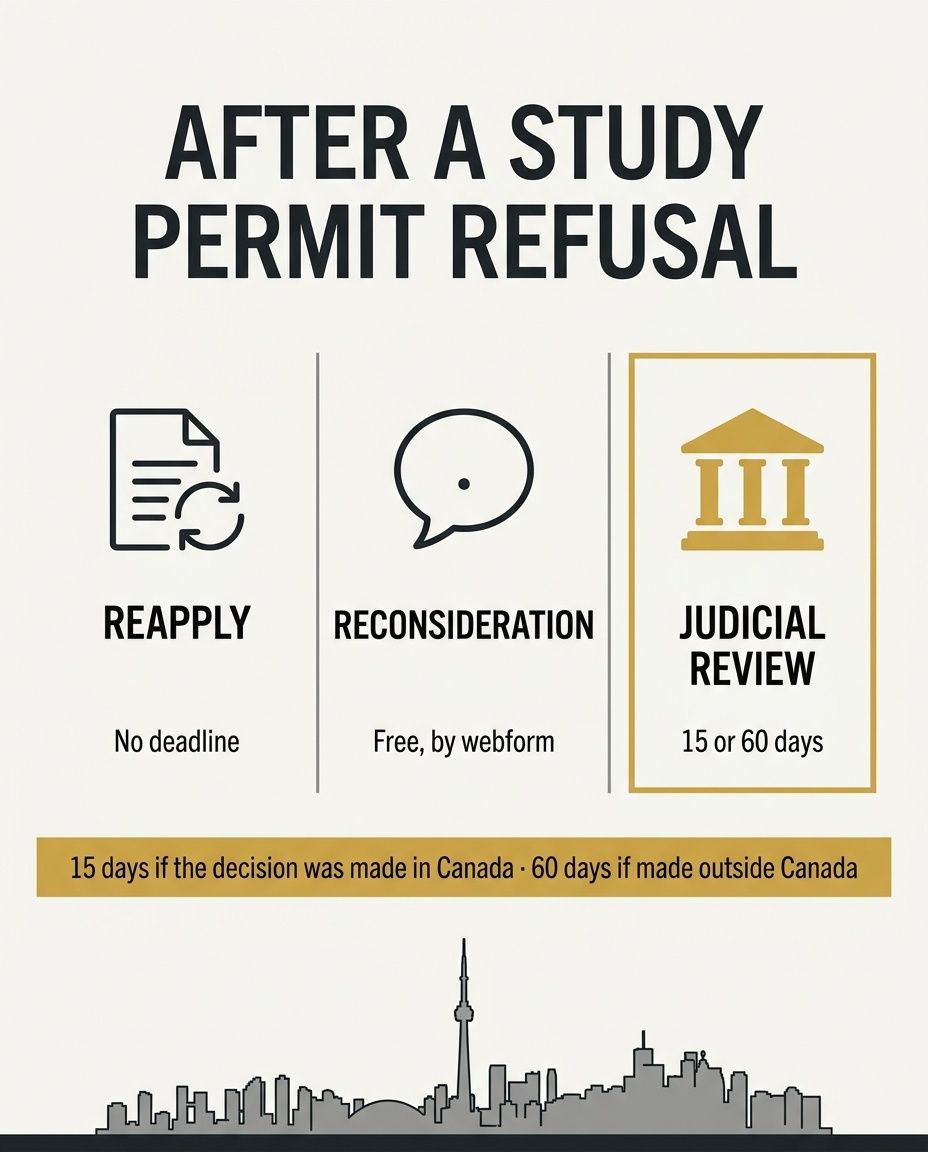
There is no appeal to a tribunal for a temporary residence refusal. No board will rehear the decision. Three routes remain.
| Route | Cost and deadline | Best suited to |
|---|---|---|
| Reapply | Full application fee, no deadline | Most applicants, where the stated concern can be answered with better evidence |
| Reconsideration request | Free, no fixed deadline | A clear officer error, such as a document that was submitted but not assessed |
| Judicial review | Court fees and counsel, 15 or 60 days | Decisions that appear unreasonable or procedurally unfair |
Reapply With a File That Answers the Stated Concern
This is what most refused applicants do. The next officer sees the earlier refusal and compares the two files, so a resubmission that looks substantially identical tends to be refused faster than the first. Address each ground directly, replace anything expired, and add evidence that did not exist before rather than reformatting what was already rejected.
Request Reconsideration Through the IRCC Webform
A reconsideration request asks the officer to look again, free of charge, through the IRCC webform. It works only where you can point to an identifiable error, and new evidence is generally not considered. Two points applicants miss: you can file a fresh application while a reconsideration is pending, and the request does not pause the judicial review clock.
Apply for Leave and Judicial Review at the Federal Court
Judicial review asks the Federal Court whether the decision was reasonable and fair. It is not a rehearing and the Court will not issue your permit. A successful application sends the file back to a different officer, and in strong cases the Department of Justice may agree to set the refusal aside without a hearing.
The deadlines are short and strictly applied. Under section 72 of the Immigration and Refugee Protection Act, you have 15 days for a matter arising in Canada and 60 days for a matter arising outside Canada. Most study permit refusals come from a visa office abroad, which gives 60 days, but applicants who assume the longer window applies to an inland refusal lose the option entirely. The Federal Court publishes the filing procedure for an application for leave and judicial review.
Restoration of Status After an Inland Refusal
If you were already in Canada and your extension or change of conditions was refused, you have 90 days from the day you lost status to apply for restoration alongside a new permit. Missing that window means leaving Canada and applying from outside. Our guide on how to change a visitor visa to a study permit sets out the underlying requirements.
Financial Screening Changes That Are Causing Refusals in 2026
Several rules tightened recently, and applications built on older guidance are refused on grounds that did not exist two years ago.

- The living-cost figure is 22,895 dollars for a single applicant outside Quebec, for applications filed on or after September 1, 2025, on top of first-year tuition and travel, rising with family size.
- The figure is adjusted every September 1 against the low-income cut-off, so an application filed in early September 2026 is assessed on the new amount, not the current one.
- Source of funds is assessed in every application, not only higher-risk cases, following IRCC's officer guidance update of July 24, 2026.
- Bank statements must cover six months rather than four, which exposes sudden pre-application deposits that previously fell outside the window.
- Bank drafts are no longer listed as acceptable proof, while pension and rental income were added.
- The Student Direct Stream closed on November 8, 2024, so guidance built around SDS no longer applies, though a GIC remains strong evidence.
Quebec assesses financial capacity separately through the CAQ process and sets its own amounts. Because these figures move annually, confirm the current requirement on the IRCC proof of financial support page before filing.
Mistakes That Cause a Second Refusal
- Refiling before the notes arrive, which means guessing at the ground of refusal.
- Adding volume instead of evidence, burying the file in documents that do not answer the officer's concern.
- Failing to declare the previous refusal, which converts a fixable problem into a misrepresentation risk.
- Leaving the acceptance letter or attestation letter expired, so the new file fails on a fresh ground.
- Using last year's financial figure, which now falls short by more than 2,000 dollars.
How SEP Immigration Helps After a Study Permit Refusal
We obtain and read the officer's notes, identify the real ground of refusal, and build the reapplication or reconsideration around it rather than around the letter's generic wording. To have your refusal assessed, book a consultation with Sepehr Falahati, a licensed immigration consultant with the College of Immigration and Citizenship Consultants (CICC/IRB, R533959).
This article is general information and not legal advice, and study permit requirements change without notice. Verify current financial thresholds and document requirements on the IRCC study permit pages before applying. Information current as of August 2026.
Frequently asked questions
01 Can you appeal a study permit refusal in Canada?
There is no formal appeal for a temporary residence refusal, so no tribunal will rehear the decision. The realistic routes are reapplying with a stronger file, asking IRCC to reconsider, or applying to the Federal Court for leave and judicial review.
02 How long do you have to wait to reapply after a study permit refusal?
There is no waiting period unless your decision letter states one. You can reapply immediately, but only once you know why you were refused and have evidence answering that concern, since refiling the same application usually produces the same result.
03 Does a previous refusal hurt a new study permit application?
A prior refusal does not disqualify you, but the next officer can see it and will read the earlier file. You must declare it, and the new application needs to visibly address what went wrong rather than repeat the original submission.
04 How much money is needed for a Canadian study permit?
For applications submitted on or after September 1, 2025, a single applicant outside Quebec must show 22,895 Canadian dollars in living costs for the first year, on top of first-year tuition and travel. The amount rises with family size, IRCC adjusts it every September 1, and Quebec sets its own figure.
05 What is the deadline to file for judicial review of a study permit refusal?
You have 15 days for a matter arising in Canada and 60 days for a matter arising outside Canada. Most study permit refusals are issued by a visa office abroad, which gives 60 days, but the clock starts when you are notified and extensions are discretionary.
About the Author

Sepehr Falahati
CEO of SEP Immigration
- CICC Licensed
- RCIC #R533959
- IRB Member
With years of experience in the Canadian immigration industry, Sepehr Falahati has built a reputation for handling complex immigration matters with professionalism, precision, and a strong client-focused approach.
Read more about Sepehr Falahati